
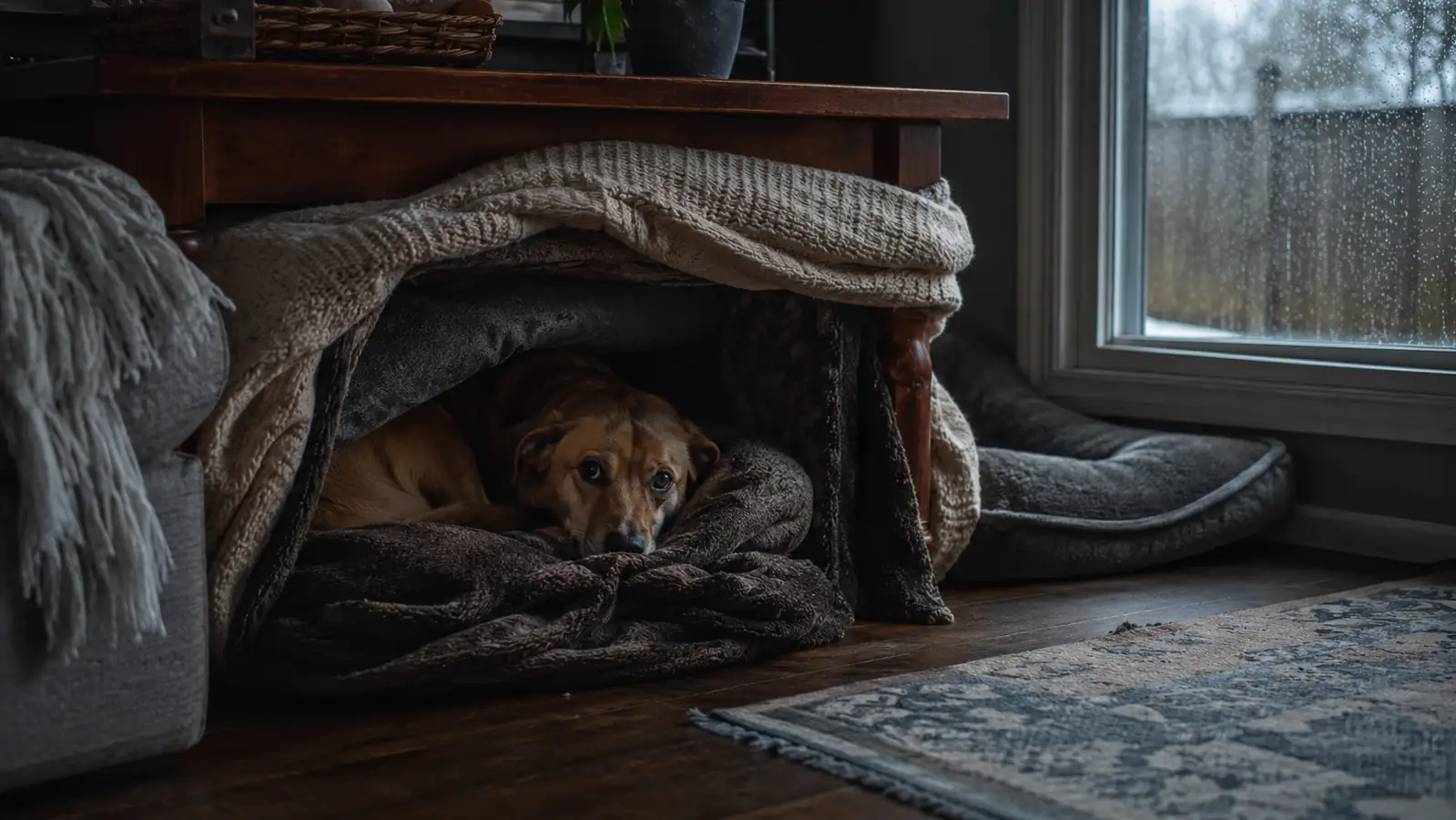
My Lab mix Biscuit will eat literally anything, including a sock once, but the second thunder rolls in he turns into a completely different dog. Ears back, panting hard, pacing between rooms, trying to wedge himself behind the toilet like it's a bunker. Maple, our senior Beagle, mostly just sighs and goes back to sleep. Pepper the cat vanishes under the bed the second the barometric pressure drops, storm or no storm, because she's dramatic about everything. But Biscuit is the one who genuinely struggles, and over the last few years I've put together a routine that actually helps him get through a storm instead of just white-knuckling it in the bathroom with me.
This isn't a miracle fix, and I want to say that up front. What follows is the exact order I do things, starting with the free stuff and ending with the calming chews that have become a regular part of storm season in our house. The calming chews are step six, not step one, and that order matters. None of it is veterinary advice, and if your dog's storm fear is more than what I'm describing here, the last section of this guide covers when it's time to stop managing it at home and get real help.
The chew I keep stocked during storm season
PREMIUM CARE Calming Chews are the product I reach for whenever the weather app starts flashing storm icons. They're not a cure, but timed right, they take the edge off Biscuit's panic enough that the rest of this routine actually works.
Amazon Check Today's Price on Amazon →Step 1: Set Up a Safe Den Space He Can Choose to Use
Before I do anything else, I make sure Biscuit has somewhere to go that feels enclosed and hidden. For us that's a covered crate in the corner of our small living room with a blanket draped over the top and sides, plus a couple of towels bunched up inside for him to burrow into. I leave the crate door open. He picked that spot himself the first year we had him, wedging into the space between the crate and the wall during a bad storm, so I just built the den around where he already wanted to be instead of deciding for him.
The key word here is choose. Some dogs want a covered crate, some want to squeeze under a bed, some want to be in the bathtub. Watch where your dog naturally tries to go during a storm and reinforce that spot rather than picking a location that's convenient for you. Enclosed, dark, and away from windows is the general pattern, but the exact spot is up to the dog.
Step 2: Cut the Visual Triggers Before the Sky Gets Loud
Lightning flashes and darkening skies can trigger anxiety before the thunder ever starts, so I close the blinds in whatever room Biscuit is in as soon as I see a storm on the radar. It's a small thing, but a room that stays evenly lit instead of flickering with lightning is noticeably calmer for him. If your dog has a favorite room, close the blinds there first and try to keep them away from big uncovered windows for the duration of the storm.
I also try to keep the house lights on at a normal level rather than sitting in the dark ourselves, since a fully dark house makes the lightning flashes stand out even more. A steady, boring, evenly lit room does a lot of quiet work here that people tend to overlook.
Step 3: Mask the Thunder Instead of Letting It Dominate the Room
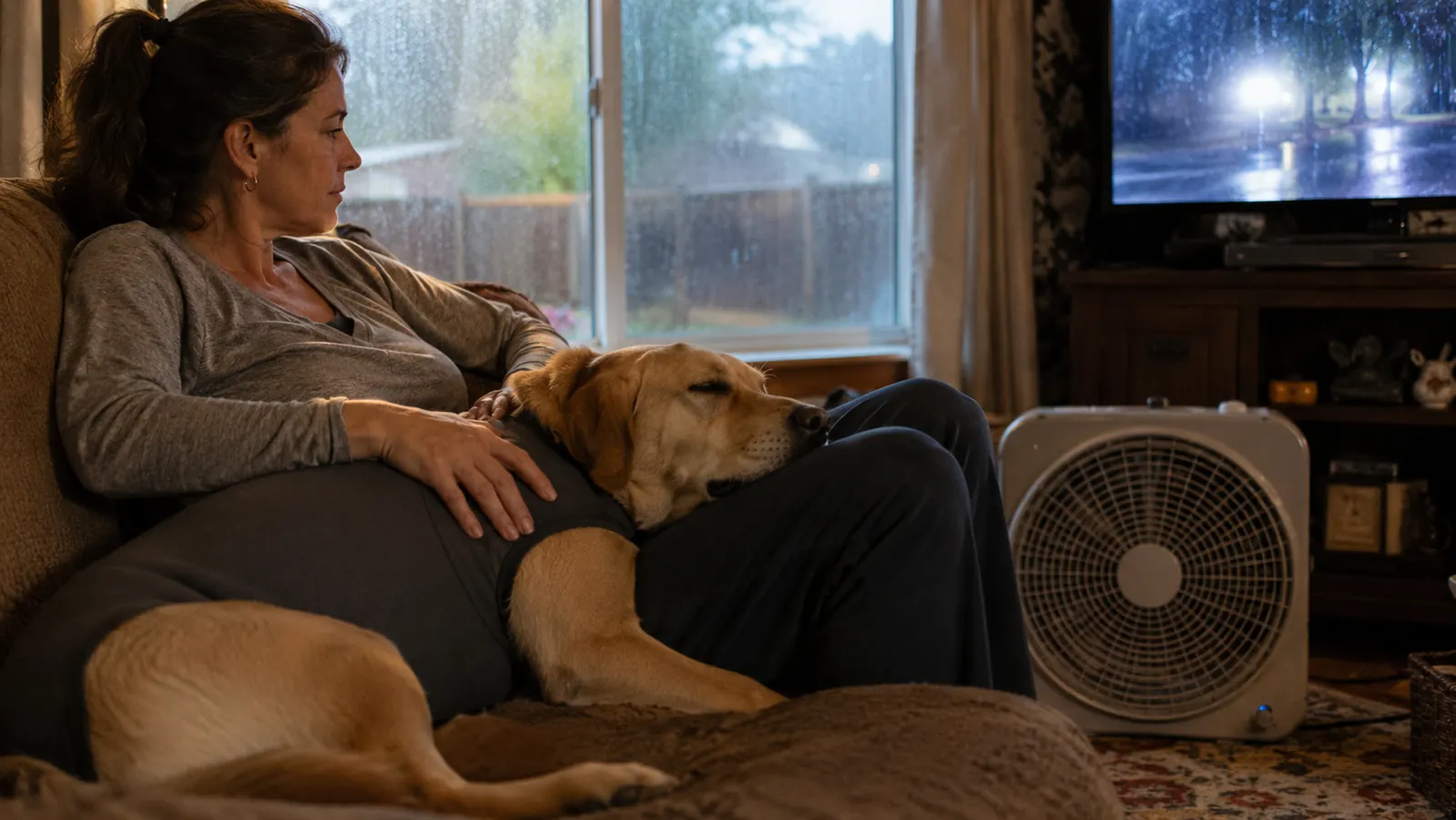
Sound is the bigger trigger for Biscuit than the flashes are, so I run a box fan near his den space and turn the TV up a bit louder than usual, something with steady background noise rather than a show full of sudden sound effects. A white noise machine works the same way if you have one. The goal isn't to hide the storm completely, since that's not really possible, but to blur the sharp cracks of thunder into something less startling.
I've found that a consistent hum works better than music with big dynamic swings. A fan or an air purifier on a medium setting has done more for Biscuit than any playlist I've tried.
Step 4: Manage Your Own Reaction, Because He's Reading You Too
I used to think comforting Biscuit during a storm would somehow reward the fear and make it worse. Our vet corrected me on that pretty firmly. Comforting an already anxious dog doesn't reinforce the anxiety the way it would with, say, jumping on guests for attention. Fear is an emotional state, not a behavior you're accidentally training. If your dog wants to be near you or leaned against you during a storm, that's fine. Let them.
What I do avoid is any kind of scolding or forced exposure. Biscuit isn't being dramatic or disobedient when he pants and paces, so telling him to knock it off or dragging him out of his den to sit with the family does nothing but add stress on top of stress. I also stay deliberately calm myself. I keep my voice normal, I don't hover over him with a worried face, and I try to go about normal activity like folding laundry or reading, because dogs pick up on our stress level as another data point about how dangerous the situation is.
If he retreats to his den and doesn't want to be touched, I let him stay there. Forcing a scared dog out of a hiding spot to cuddle on the couch is more about our own comfort than theirs. Sometimes the most helpful thing I do is just sit quietly near the crate without making him come to me.
Step 5: Try a Snug Wrap or Shirt
A tight, swaddled feeling calms a lot of anxious dogs the same way swaddling calms a baby, and it's genuinely helped Biscuit on rougher storm days. We use a snug compression wrap that fastens around his torso, though a fitted t-shirt in a pinch does something similar in a low-key way. He tolerates it better than I expected the first time I put it on him, and now he mostly just goes still once it's on, which is about as close to relaxed as storm-day Biscuit gets.
It's not a fix by itself, and it doesn't work for every dog. Some dogs find the pressure uncomfortable rather than soothing, so introduce it on a calm day first and watch how your dog responds before you count on it during an actual storm.
Step 6: Give a Calming Chew Ahead of the Storm, Not During It
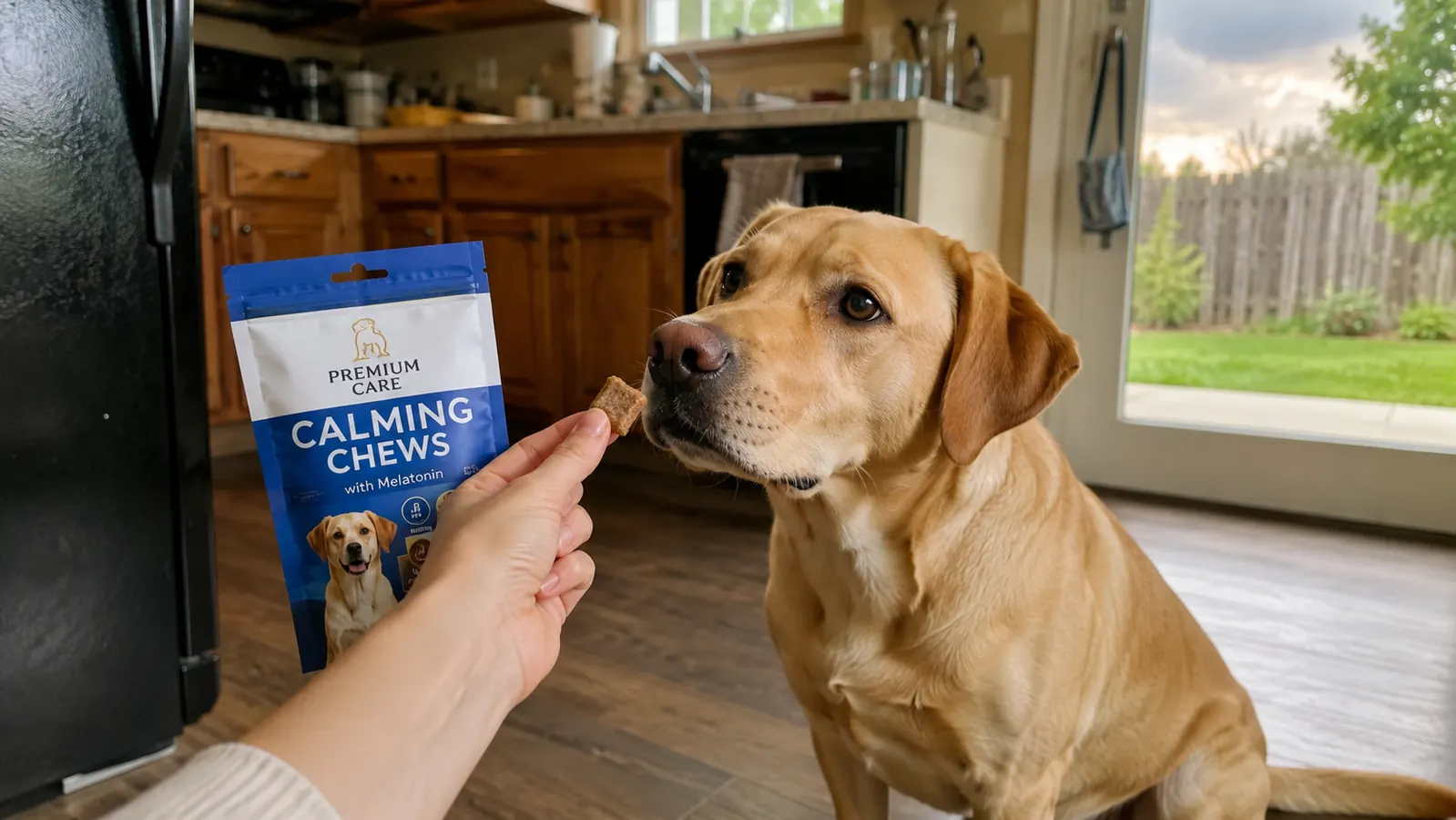
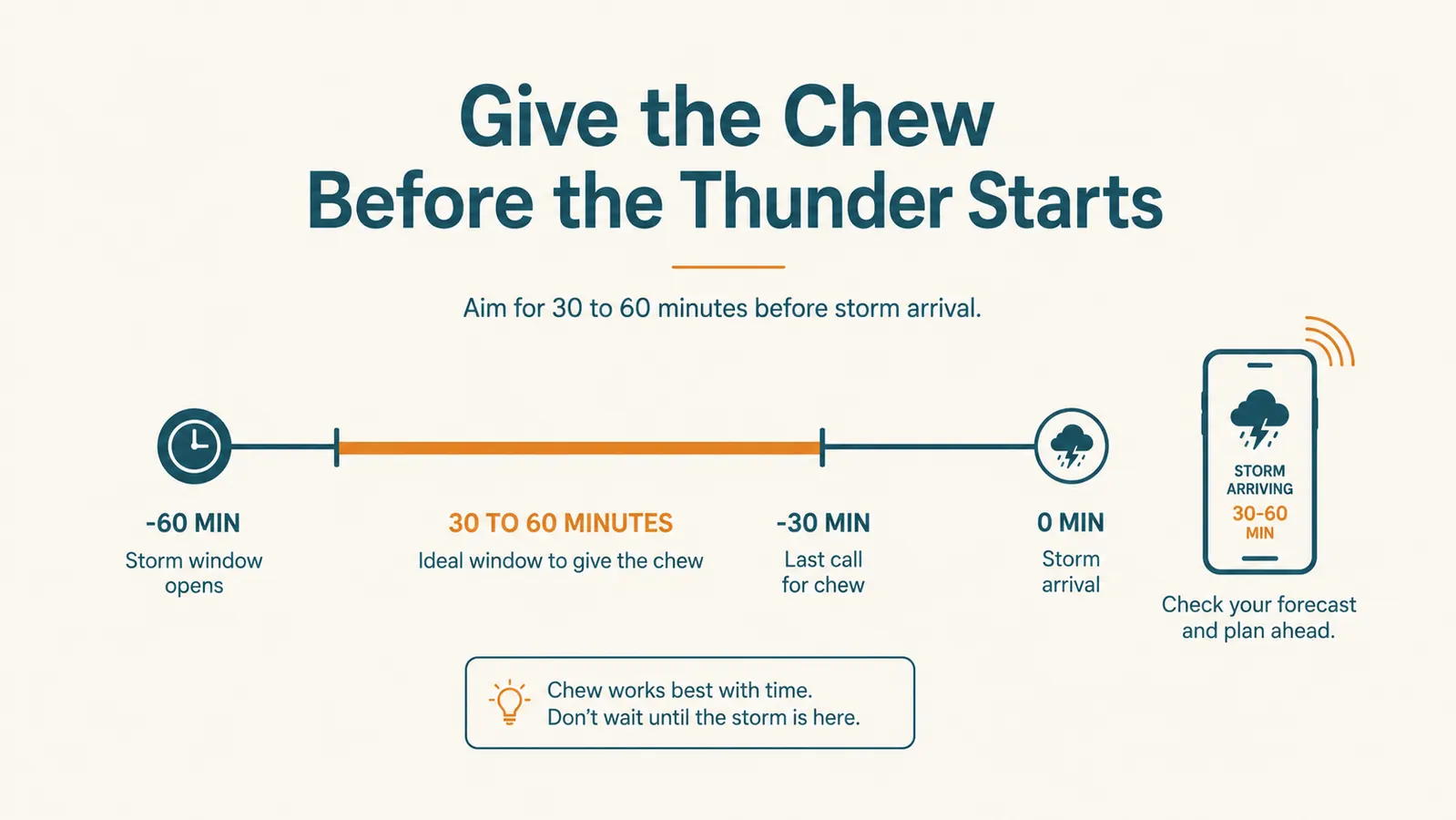
This is the step that took me the longest to get right, mostly because I kept doing it too late. Calming chews like the PREMIUM CARE ones we use aren't fast-acting the way a prescription sedative would be. They need time to actually take effect, so waiting until Biscuit is already pacing and panting means the chew is basically playing catch-up against a panic that's already in full swing.
Now I check the weather forecast in the morning, and if there's a storm predicted for later in the day, I give Biscuit a chew thirty to sixty minutes before it's expected to roll in, not after the first clap of thunder. That timing has made a real, noticeable difference. He's still not thrilled about storms, but the edge comes off faster and he settles into his den instead of pacing the whole house.
The ingredients in these are the usual calming blend you'll see across most products in this category, things meant to take the edge off everyday stress rather than sedate a dog. I want to be honest that for a dog with a mild to moderate storm reaction like Biscuit's, that's been enough paired with everything else in this routine. It's close to 50,000 reviews on Amazon at a solid rating, so a lot of other households are running the same experiment and landing somewhere similar. But a chew alone is not a treatment for a genuinely severe phobia, and I'll get into what that looks like below.
Step 7: Practice with Recorded Storm Sounds on Calm Days
This is the slow, long-term piece, and it's the one I'll admit I've been inconsistent about, but the sessions I have done have helped. On a totally calm, sunny day, I play a thunderstorm recording on my phone at a very low volume while Biscuit is relaxed and doing something normal like chewing a bone. If he stays relaxed, I let it play a few minutes and then stop, sometimes with a treat afterward. If he tenses up, I've turned the volume down too little and back off.
Over weeks, not days, I've very gradually increased the volume on days he's calm and receptive. This is genuinely slow work, and I don't do it during actual storm season when he's already primed to be anxious. It's a between-storms project, done a few minutes at a time, and it's meant to build up tolerance over months rather than fix anything overnight.
What Else Helps
A few smaller things round out our routine. I make sure Biscuit's collar and tags are on and secure during storm season specifically, since a surprising number of dogs bolt or try to escape a yard during thunder, even ones who are normally fine off leash. I also glance at the extended forecast a couple of days out during storm-heavy months so I'm not caught off guard without a chew on hand. Planning ahead has honestly done as much for our success rate as any single product.
I keep Biscuit's exercise a little heavier on days storms are forecast too, a longer walk earlier when the weather's still clear, since a dog who's already a bit tired tends to settle into his den more easily than one who's wound up.
The first time I saw Biscuit walk into his den on his own, before the thunder even started, I knew the routine had actually sunk in for him, not just for me.
I also want to be straightforward about the limits of everything in this guide. Storm phobia in dogs is a real, documented anxiety condition, and for some dogs it's severe enough that a supplement and a snug shirt aren't going to touch it. If your dog is destroying door frames or crates trying to escape, hurting themselves scratching or chewing during a storm, drooling excessively, or panicking to the point of injuring themselves or breaking through a fence, that's past the point of home management. That's a conversation with your vet about prescription anti-anxiety medication and possibly a referral to a veterinary behaviorist, who can build a structured desensitization plan far more precise than what I'm doing on my living room floor. None of this article is a substitute for that kind of professional evaluation, and a chew that works fine for a dog like Biscuit is not going to be enough for a dog in true crisis.
Have the chew ready before the next storm rolls in
If your dog's storm anxiety is mild to moderate, like Biscuit's, timing a calming chew ahead of the weather along with a safe den space and some sound masking can genuinely help. Talk to your vet if you're not sure it's right for your dog.
Amazon Check Today's Price on Amazon →